
Smart Behavior
Memory Formation
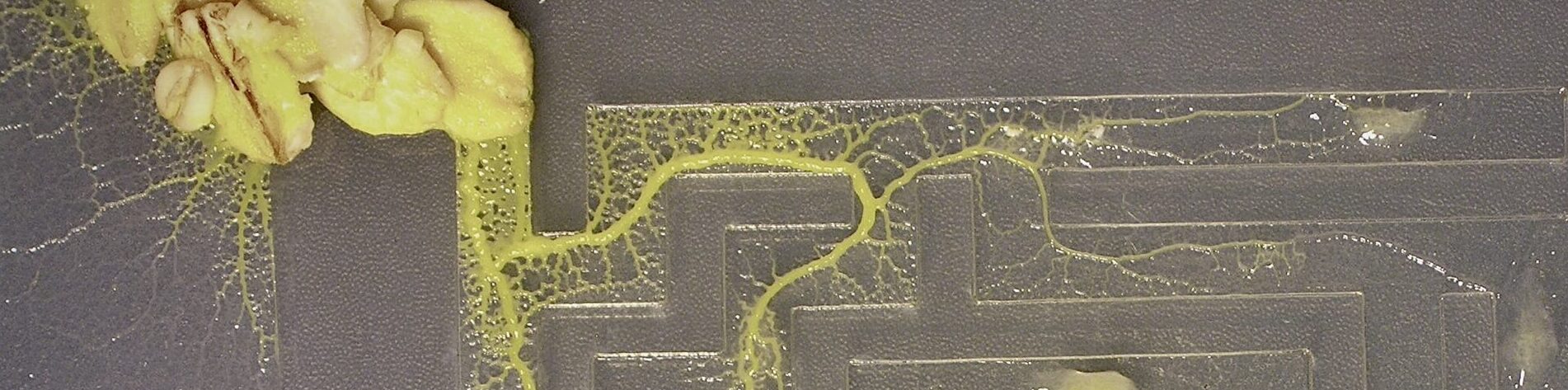
Adaptive flow networks propagate information encoded in soluble signal concentration or fluid shear force by fluid flow and store information in their pattern of thick and thin veins.
- Memory capacity of adaptive flow networks.
Komal Bhattacharyya, David Zwicker, and Karen Alim,
[Phys. Rev. E 2022] [arXiv 2023] [PDF] - Memory formation in adaptive networks.
Komal Bhattacharyya, David Zwicker, and Karen Alim,
[Phys. Rev. Lett. 2022] [PDF] [Press English] [Press German] - Encoding memory in tube diameter hierarchy of living flow network.
Mirna Kramar and Karen Alim,
[Proc. Natl. Acad. Sci. U.S.A. 2021] [PDF] [Press English] [Press German] - Mechanism of signal propagation in Physarum polycephalum.
Karen Alim, Natalie Andrew, Anne Pringle, and Michael P. Brenner,
[Proc. Natl. Acad. Sci. U.S.A. 2017] [PDF] [Press German] [Press English]
Decision Making
The decision migration direction in multi-nucleated Physarum polycephalum goes hand in hand with dynamic transcriptome and contraction pattern.
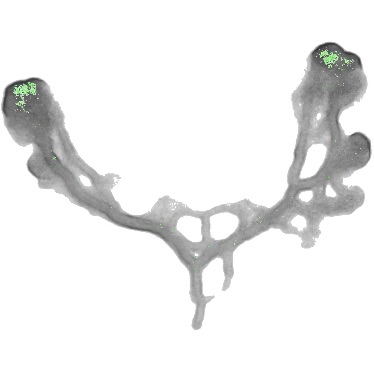
- Coexistence of trapped and flow-transported nuclei enables fast pigeon post communication across multinucleated cell.
Johnny Tong, Kaspar Wachinger, Fabian K. Henn, Nico Schramma, Siyu Chen, Karen Alim,
[Proc. Natl. Acad. Sci. U.S.A. 2025] [PDF] - Spatial transcriptomic and single-nucleus analysis reveals heterogeneity in a gigantic single-celled syncytium.
Tobias Gerber, Cristina Loureiro, Nico Schramma, Siyu Chen, Akanksha Jain, Anne Weber, Anne Weigert, Malgorzata Santel, Karen Alim, Barbara Treutlein, and J Gray Camp
[eLife 2022][PDF] - Emergence of behavior in a self-organized living matter network.
Philipp Fleig, Mirna Kramar, Michael Wilczek, and Karen Alim,
[eLife 2022][PDF]
Migration
Trails of self-repellent slime and dynamic network architecture in Physarum polycephalum allow for migration strategies superior to typical single cells.
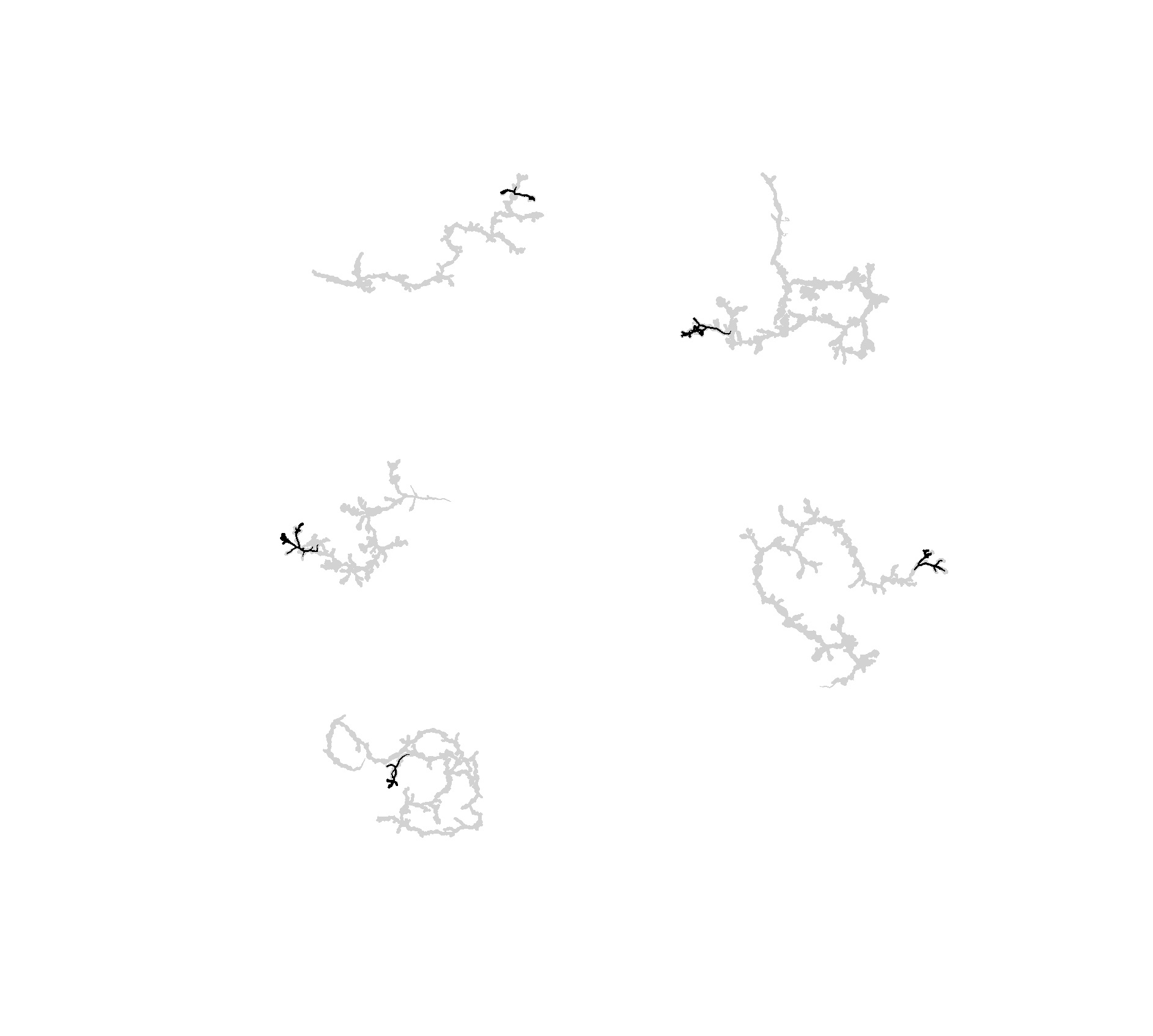
- Size-dependent self-avoidance enables superdiffusive migration in macroscopic unicellulars.
Lucas Tröger, Florian Goirand, and Karen Alim,
[Proc. Natl. Acad. Sci. 2024][PDF]